Average Reviews:

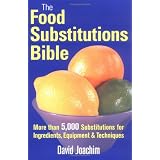
(More customer reviews)`The Food Substitutions Bible' by David Joachim runs a big risk in assuming such a pretentious title, as it simply invites a search for things which are missing in order to take it down a peg or two. I have to say, however, that compared to several other `bible' titles published by this `Robert Rose, Inc.' company, this book more than lives up to its promise. On the way, it happens to fill a great need in one's culinary library.
Most good cooking manuals have substitutions and `how to make' for several of the more common pantry items such as buttermilk, lemon juice, crème fraiche, and preserved lemons. It it's an especially good book, it may have as many as 100 such substitutions. This book advertises `more than 5000 substitutions'. The book doesn't just stop at one substitution or recipe for each item. Many options have three or four or five. It also does not stop with formulas or recipes. It does an excellent job, for example, of giving substitutions for common cooking tools such as a zester or a potato ricer.
Of course, I could not resist trying to find things the book missed. I am happy to say I did find a few, but I am also happy to say that with one exception, they were all very obscure. I found no entries for the ancient Roman fermented fish sauce, `garum' or the traditional French sour grape condiment, `verjus' or the middle eastern spice, `Aleppo pepper' or the North African pantry item, salt preserved lemon. I think all these are fair, in that I have seen recipes for all these in at least one cookbook and I have seen all of them used in at least two modern cookbooks.
I also felt some of the substitutions were just a bit less than useful, as the item being substituted may have been just as hard or harder to come by than the missing ingredient. For example, if I don't have venison, it is highly unlikely I will have antelope meat or gazelle meat or buffalo meat. Fortunately, this observation is generally a quibble, as we are also given `beef' as a substitute for venison.
My last quibble with these entries is that several substitutions are a bit questionable for all but the most casual situations. For example, suggested substitutions for mozzarella are Gouda, provolone, Muenster, and Fontina. I think all of these are much too strongly flavored to act as a good substitute for classic mozzarella uses. I suppose that if all you want is `some soft cheese', these would work, but I would question all of these in a baked dish or in classic raw dishes such as the Caprese salad.
The other side of the coin is brilliantly represented by the ingredient guides in the back of the book including apples, rice, clams, pears, dried beans, lentils, olives, mushrooms, potatoes, chiles (fresh and dried), flour (wheat and alternatives), Asian noodles, roe, crabs, oils, vinegars, and salts. These pages alone are worth the price of the book. I am forever trying to remember which apples are best for baking and which clams are best for chowder. I will have to puzzle no longer.
Oddly, this book will probably be more of a service to experienced cooks than to rank amateurs, as it is at its best with unusual ingredients. The experienced cook will also be much better at identifying the good from the bad substitutions.
Very highly recommended for all cooks!
Click Here to see more reviews about: The Food Substitutions Bible: More than 5,000 Substitutions for Ingredients, Equipment and Techniques
The best and most complete substitutions guide, by the author of A Man, A Can, A Plan.
Some of the greatest cooking discoveries are the result of creatively substituting one ingredient, one piece of equipment, or one cooking technique for another.
The Food Substitutions Bible compiles all types of substitutions into one comprehensive, easy-to-use handbook. Simply organized from A to Z, its 1,500 entries have more than 5,000 substitutions. This reference covers:
Common cooking measure equivalents
Metric conversion tables
International equivalency tables for temperature, weight and volume
Emergency substitutions
Time-saving substitutions
Healthy substitutions
Alternatives for hard-to-find and ethnic ingredients
Alternatives for vegetarians
Innovative ideas for varying the flavor of a dish in countless ways
Every substitution includes instructions with exact proportions for accurate, reliable replacements. When multiple substitutions are given within an entry, they are organized into categories for quick reference. Some of these include: If You Don't Have It, To Vary the Flavor, To Save Time, and For Better Health. The book also has an appendix with handy reference charts.
The Food Substitutions Bible is the most authoritative, comprehensive and easy-to-use book on substitutions ever published.
(20051225)


0 comments:
Post a Comment