Average Reviews:

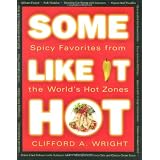
(More customer reviews)`Some Like It Hot' by noted culinary writer, Clifford A. Wright is a real gem. I was surprised to find such a book written by Wright, who is one of the leading scholarly experts on food of the Mediterranean, and, as he so elegantly illustrates himself, the Mediterranean is hot a hotbed of spicy foods.
Therefore, Wright's primary focus is on the various world spicy cuisines. He identifies the following centers of spicy food culture:
Western South America, primarily Peru and Bolivia.
Mexico and Southwestern U.S.
Cajun Cuisine
Jamaica
Western coast of Africa, primarily Senegal, Guinea, Sierra Leone, Liberia, Ghana, and Nigeria
North Africa (the Madgreb) of Algeria and Tunesia
Eastern Africa, especially Ethopia
Yemen
India and Pakistan
Thailand
Sichuan and Hunan provinces in China
Korea
These cuisines are discussed in detail in sidebars scattered throughout the recipe chapters.
The very odd thing about this list is how widely separate these regions are, especially since the single plant genus, the chile, grows so easily in all sorts of tropical, subtropical, and temperate climates. I am quite happy to see Wright confirm a hunch I had about capsicum genus (composed of five different species from the very mild bell pepper to the thermonuclear Habanero) that it's arrival in Europe and Asia simply blew away all piquant competion by its being so much stronger and so cheap to grow.
The most important `academic' study Wright covers is why some groups of people like hot food. He reviews and dismisses fourteen different common and not so common hypotheses, reaching the one that simply says people like the way they taste. What Wright does not do is explain why these particular regions embraced hot food and so many other regions did not. Why, for example, is Spanish cuisine so in love with the sweet bell pepper (capsicum annuum) which came from Mexico (note all those red pimentos, which are pickled sweet peppers) yet they do not embrace the chiles with high heat. It is easy to understand South America, Mexico, and Jamaica, as genus capsicum is native to these lands. It is also easy to understand India and Pakistan and Sichuan and Hunan, as both cuisines have a history of creating spicy dishes based on the pre-chile spices of black pepper, cloves, cinnamon, ginger, galangal, and tamarind. But what about the west coast of Africa, Ethopia, and Yemen? Wright never gets around to answering this question, but we quickly loose interest in the academic questions when the Professor gets down to the recipes.
While Wright claims to not be a chile head, he cannot escape the fact that the capsicum chile is by far the strongest source of culinary heat. Therefore, virtually all recipes include one or more varieties of chile in the ingredients.
The recipes are all organized by type of dish, with chapters on:
Startling Starters
Sexy Salads
Searing Soups
Electrifying Eggs
Hot Chicks, Wicked Ducks, and One Killer Rabbit (with apologies to Monty Python)
Blazing Beef and Indendiary Lamb
Piquant Pork
Sassy Seafoof
Volatile Vegetables
Pizzazz Pasta, Napalm Noodles, and Fiery Rice
Hot Accompaniments
Cool Accompaniments
Basic Sauces, Pastes, and Seasonings
Within each chapter, recipes are organized by location, following the same geographical order laid out above, always beginning with the New World source of chiles. And, not all cuisines are represented in all chapters.
In these recipes, Wright has done some adaptation to American kitchens and markets, but not much. That means that like just about any good survey of a regional cuisine (other than one native to North America), you will have to do a little culinary spelunking to locate some of the more important ingredients. And, since the books covers many cuisines from around the world, this means you will be stocking up on a LOT of esoteric ingredients to do these recipes. This is not only various kinds of chile, but also special sausages, fats, pastes, and sauces. Wright suggests some substitutions, but also confesses that most substitutions simply cannot give you the flavor of the original. It also means you will be doing a lot of cooking with animal fats such as lard and duck fat.In addition to being very close to authentic, all recipes are described with exceptional care.
To handle this problem, Wright provides two very important tools. The first is his last chapter of recipes for `Basic Sauces, Pastes, and Seasonings'. The second is one of the longest listings of Internet sources I have yet seen, including the great section in Paula Wolfert's exceptional book on the cooking or southwestern France.
Like Wolfert's book, this book is worth it even if you do nothing more than read it and pick out just those few recipes for which you can find ingredients easily. But, if you love your heat, you will really want to explore some of the more esoteric dishes, simply to get the different flavors from the many different varieties of chiles and the sauces and pastes into which they are made.
If you like hot food, this book is a must. If you are simply a foodie, this book is a must read, as Wright rarely missteps in his analysis of culinary matters.
Click Here to see more reviews about: Some Like It Hot: Spicy Favorites from the World's Hot Zones
 Get 31% OFF
Click here for more information about Some Like It Hot: Spicy Favorites from the World's Hot Zones

0 comments:
Post a Comment